
https://github.com/junegunn/vim-plug.git
 Junegunn Choi
d863d07832
Add more explanation on plug#end()
Junegunn Choi
d863d07832
Add more explanation on plug#end()
|
před 2 roky | |
|---|---|---|
| .github | před 3 roky | |
| doc | před 2 roky | |
| test | před 2 roky | |
| .gitignore | před 4 roky | |
| .travis.yml | před 6 roky | |
| LICENSE | před 9 roky | |
| README.md | před 2 roky | |
| plug-dark.png | před 2 roky | |
| plug.png | před 11 roky | |
| plug.vim | před 2 roky |
README.md



A minimalist Vim plugin manager.

Pros.
- Minimalist design
- Just one file with no dependencies. Super easy to set up.
- Concise, intuitive syntax that you can learn within minutes. No boilerplate code required.
- No feature bloat
- Extremely stable with flawless backward compatibility
- Works perfectly with all versions of Vim since 2006 and all versions of Neovim ever released
- Super-fast parallel installation/update
- Creates shallow clones to minimize disk space usage and download time
- On-demand loading for faster startup time
- Can review and rollback updates
- Branch/tag/commit support
- Post-update hooks
- Support for externally managed plugins
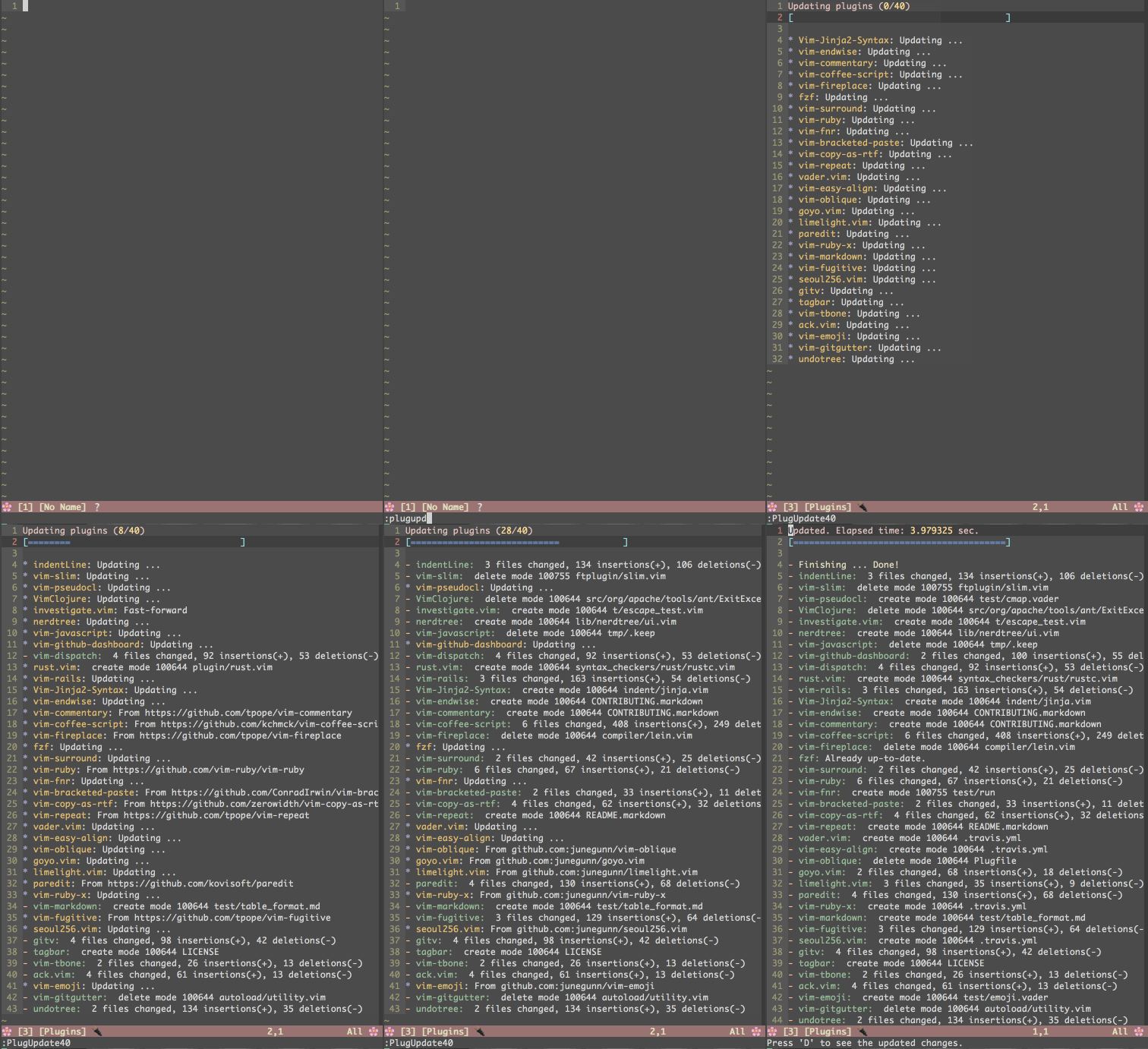
Installation
Download plug.vim and put it in the "autoload" directory.
Click to see the instructions
### Vim #### Unix ```sh curl -fLo ~/.vim/autoload/plug.vim --create-dirs \ https://raw.githubusercontent.com/junegunn/vim-plug/master/plug.vim ``` You can automate the process by putting the command in your Vim configuration file as suggested [here][auto]. #### Windows (PowerShell) ```powershell iwr -useb https://raw.githubusercontent.com/junegunn/vim-plug/master/plug.vim |` ni $HOME/vimfiles/autoload/plug.vim -Force ``` ### Neovim #### Unix, Linux ```sh sh -c 'curl -fLo "${XDG_DATA_HOME:-$HOME/.local/share}"/nvim/site/autoload/plug.vim --create-dirs \ https://raw.githubusercontent.com/junegunn/vim-plug/master/plug.vim' ``` #### Linux (Flatpak) ```sh curl -fLo ~/.var/app/io.neovim.nvim/data/nvim/site/autoload/plug.vim --create-dirs \ https://raw.githubusercontent.com/junegunn/vim-plug/master/plug.vim ``` #### Windows (PowerShell) ```powershell iwr -useb https://raw.githubusercontent.com/junegunn/vim-plug/master/plug.vim |` ni "$(@($env:XDG_DATA_HOME, $env:LOCALAPPDATA)[$null -eq $env:XDG_DATA_HOME])/nvim-data/site/autoload/plug.vim" -Force ```Usage
Add a vim-plug section to your ~/.vimrc (or ~/.config/nvim/init.vim for Neovim)
- Begin the section with
call plug#begin() - List the plugins with
Plugcommands - End the section with
call plug#end()
For example,
call plug#begin()

" List your plugins here
Plug 'tpope/vim-sensible'

call plug#end()
Reload the file or restart Vim, then you can,
:PlugInstallto install the plugins:PlugUpdateto install or update the plugins:PlugDiffto review the changes from the last update:PlugCleanto remove plugins no longer in the list
[!NOTE] That's basically all you need to know to get started. The rest of the document is for advanced users who want to know more about the features and options.
[!TIP]
plug#end()automatically executesfiletype plugin indent onandsyntax enable. We believe this is a good default for most users, but if you don't want this behavior, you can revert the settings after the call.> call plug#end() > filetype indent off " Disable file-type-specific indentation > syntax off " Disable syntax highlighting > ``` ### Getting Help - See [tutorial] page to learn more about the basics of vim-plug - See [tips] and [FAQ] pages for common problems and questions ## Examples The following examples demonstrate the additional features of vim-plug. ### Vim script examplevim call plug#begin() " The default plugin directory will be as follows: " - Vim (Linux/macOS): '~/.vim/plugged' " - Vim (Windows): '~/vimfiles/plugged' " - Neovim (Linux/macOS/Windows): stdpath('data') . '/plugged' " You can specify a custom plugin directory by passing it as the argument " - e.g.
call plug#begin('~/.vim/plugged')" - Avoid using standard Vim directory names like 'plugin'
" Make sure you use single quotes
" Shorthand notation for GitHub; translates to https://github.com/junegunn/seoul256.vim.git Plug 'junegunn/seoul256.vim'
" Any valid git URL is allowed Plug 'https://github.com/junegunn/vim-easy-align.git'
" Using a tagged release; wildcard allowed (requires git 1.9.2 or above) Plug 'fatih/vim-go', { 'tag': '*' }
" Using a non-default branch Plug 'neoclide/coc.nvim', { 'branch': 'release' }
" Use 'dir' option to install plugin in a non-default directory Plug 'junegunn/fzf', { 'dir': '~/.fzf' }
" Post-update hook: run a shell command after installing or updating the plugin Plug 'junegunn/fzf', { 'dir': '~/.fzf', 'do': './install --all' }
" Post-update hook can be a lambda expression Plug 'junegunn/fzf', { 'do': { -> fzf#install() } }
" If the vim plugin is in a subdirectory, use 'rtp' option to specify its path Plug 'nsf/gocode', { 'rtp': 'vim' }
" On-demand loading: loaded when the specified command is executed Plug 'preservim/nerdtree', { 'on': 'NERDTreeToggle' }
" On-demand loading: loaded when a file with a specific file type is opened Plug 'tpope/vim-fireplace', { 'for': 'clojure' }
" Unmanaged plugin (manually installed and updated) Plug '~/my-prototype-plugin'
" Call plug#end to update &runtimepath and initialize the plugin system.
" - It automatically executes filetype plugin indent on and syntax enable
call plug#end()
" You can revert the settings after the call like so:
" filetype indent off " Disable file-type-specific indentation
" syntax off " Disable syntax highlighting
" Color schemes should be loaded after plug#end(). " We prepend it with 'silent!' to ignore errors when it's not yet installed. silent! colorscheme seoul256
### Lua example for Neovim

In Neovim, you can write your configuration in a Lua script file named
`init.lua`. The following code is the Lua script equivalent to the Vim script
example above.
lua local vim = vim local Plug = vim.fn['plug#']
vim.call('plug#begin')
-- Shorthand notation for GitHub; translates to https://github.com/junegunn/seoul256.vim.git Plug('junegunn/seoul256.vim')
-- Any valid git URL is allowed Plug('https://github.com/junegunn/vim-easy-align.git')
-- Using a tagged release; wildcard allowed (requires git 1.9.2 or above) Plug('fatih/vim-go', { ['tag'] = '*' })
-- Using a non-default branch Plug('neoclide/coc.nvim', { ['branch'] = 'release' })
-- Use 'dir' option to install plugin in a non-default directory Plug('junegunn/fzf', { ['dir'] = '~/.fzf' })
-- Post-update hook: run a shell command after installing or updating the plugin Plug('junegunn/fzf', { ['dir'] = '~/.fzf', ['do'] = './install --all' })
-- Post-update hook can be a lambda expression Plug('junegunn/fzf', { ['do'] = function() vim.fn['fzf#install']() end })
-- If the vim plugin is in a subdirectory, use 'rtp' option to specify its path Plug('nsf/gocode', { ['rtp'] = 'vim' })
-- On-demand loading: loaded when the specified command is executed Plug('preservim/nerdtree', { ['on'] = 'NERDTreeToggle' })
-- On-demand loading: loaded when a file with a specific file type is opened Plug('tpope/vim-fireplace', { ['for'] = 'clojure' })
-- Unmanaged plugin (manually installed and updated) Plug('~/my-prototype-plugin')
vim.call('plug#end')
-- Color schemes should be loaded after plug#end(). -- We prepend it with 'silent!' to ignore errors when it's not yet installed. vim.cmd('silent! colorscheme seoul256')
## Commands

| Command                             | Description                                                        |
| ----------------------------------- | ------------------------------------------------------------------ |
| `PlugInstall [name ...] [#threads]` | Install plugins                                                    |
| `PlugUpdate [name ...] [#threads]`  | Install or update plugins                                          |
| `PlugClean[!]`                      | Remove unlisted plugins (bang version will clean without prompt)   |
| `PlugUpgrade`                       | Upgrade vim-plug itself                                            |
| `PlugStatus`                        | Check the status of plugins                                        |
| `PlugDiff`                          | Examine changes from the previous update and the pending changes   |
| `PlugSnapshot[!] [output path]`     | Generate script for restoring the current snapshot of the plugins  |

## `Plug` options

| Option                  | Description                                                 |
| ----------------------- | ----------------------------------------------------------- |
| `branch`/`tag`/`commit` | Branch/tag/commit of the repository to use                  |
| `rtp`                   | Subdirectory that contains Vim plugin                       |
| `dir`                   | Custom directory for the plugin                             |
| `as`                    | Use different name for the plugin                           |
| `do`                    | Post-update hook (string or funcref)                        |
| `on`                    | On-demand loading: Commands or `<Plug>`-mappings            |
| `for`                   | On-demand loading: File types                               |
| `frozen`                | Do not remove and do not update unless explicitly specified |

## Global options

| Flag                | Default                           | Description                                            |
| ------------------- | --------------------------------- | ------------------------------------------------------ |
| `g:plug_threads`    | 16                                | Default number of threads to use                       |
| `g:plug_timeout`    | 60                                | Time limit of each task in seconds (*Ruby & Python*)   |
| `g:plug_retries`    | 2                                 | Number of retries in case of timeout (*Ruby & Python*) |
| `g:plug_shallow`    | 1                                 | Use shallow clone                                      |
| `g:plug_window`     | `-tabnew`                         | Command to open plug window                            |
| `g:plug_pwindow`    | `vertical rightbelow new`         | Command to open preview window in `PlugDiff`           |
| `g:plug_url_format` | `https://git::@github.com/%s.git` | `printf` format to build repo URL (Only applies to the subsequent `Plug` commands) |


## Keybindings

- `D` - `PlugDiff`
- `S` - `PlugStatus`
- `R` - Retry failed update or installation tasks
- `U` - Update plugins in the selected range
- `q` - Close the window
- `:PlugStatus`
    - `L` - Load plugin
- `:PlugDiff`
    - `X` - Revert the update

## Post-update hooks

There are some plugins that require extra steps after installation or update.
In that case, use the `do` option to describe the task to be performed.
vim Plug 'Shougo/vimproc.vim', { 'do': 'make' } Plug 'ycm-core/YouCompleteMe', { 'do': './install.py' }
If the value starts with `:`, it will be recognized as a Vim command.
vim Plug 'fatih/vim-go', { 'do': ':GoInstallBinaries' }
To call a Vim function, you can pass a lambda expression like so:
vim Plug 'junegunn/fzf', { 'do': { -> fzf#install() } }
If you need more control, you can pass a reference to a Vim function that
takes a dictionary argument.
vim function! BuildYCM(info) " info is a dictionary with 3 fields " - name: name of the plugin " - status: 'installed', 'updated', or 'unchanged' " - force: set on PlugInstall! or PlugUpdate! if a:info.status == 'installed' || a:info.force
!./install.py
endif endfunction
Plug 'ycm-core/YouCompleteMe', { 'do': function('BuildYCM') }
A post-update hook is executed inside the directory of the plugin and only run
when the repository has changed, but you can force it to run unconditionally
with the bang-versions of the commands: `PlugInstall!` and `PlugUpdate!`.

> [!TIP]
> Make sure to escape BARs and double-quotes when you write the `do` option
> inline as they are mistakenly recognized as command separator or the start of
> the trailing comment.
>
> ```vim
> Plug 'junegunn/fzf', { 'do': 'yes \| ./install' }
> ```
>
> But you can avoid the escaping if you extract the inline specification using a
> variable (or any Vim script expression) as follows:
>
> ```vim
> let g:fzf_install = 'yes | ./install'
> Plug 'junegunn/fzf', { 'do': g:fzf_install }
> ```

### `PlugInstall!` and `PlugUpdate!`

The installer takes the following steps when installing/updating a plugin:

1. `git clone` or `git fetch` from its origin
2. Check out branch, tag, or commit and optionally `git merge` remote branch
3. If the plugin was updated (or installed for the first time)
    1. Update submodules
    2. Execute post-update hooks

The commands with the `!` suffix ensure that all steps are run unconditionally.

## On-demand loading of plugins
vim " NERD tree will be loaded on the first invocation of NERDTreeToggle command Plug 'preservim/nerdtree', { 'on': 'NERDTreeToggle' }
" Multiple commands Plug 'junegunn/vim-github-dashboard', { 'on': ['GHDashboard', 'GHActivity'] }
" Loaded when clojure file is opened Plug 'tpope/vim-fireplace', { 'for': 'clojure' }
" Multiple file types Plug 'kovisoft/paredit', { 'for': ['clojure', 'scheme'] }
" On-demand loading on both conditions Plug 'junegunn/vader.vim', { 'on': 'Vader', 'for': 'vader' }
" Code to execute when the plugin is lazily loaded on demand Plug 'junegunn/goyo.vim', { 'for': 'markdown' } autocmd! User goyo.vim echom 'Goyo is now loaded!' ```
[!NOTE]
Should I set up on-demand loading?
You probably don't need to.
A properly implemented Vim plugin should already load lazily without any help from a plugin manager (
:help autoload). So there are few cases where these options actually make much sense. Making a plugin load faster is the responsibility of the plugin developer, not the user. If you find a plugin that takes too long to load, consider opening an issue on the plugin's issue tracker.Let me give you a perspective. The time it takes to load a plugin is usually less than 2 or 3ms on modern computers. So unless you use a very large number of plugins, you are unlikely to save more than 50ms. If you have spent an hour carefully setting up the options to shave off 50ms, you will have to start Vim 72,000 times just to break even. You should ask yourself if that's a good investment of your time.
Make sure that you're tackling the right problem by breaking down the startup time of Vim using
--startuptime.vim --startuptime /tmp/logOn-demand loading should only be used as a last resort. It is basically a hacky workaround and is not always guaranteed to work.
[!TIP] You can pass an empty list to
onorforoption to disable the loading of the plugin. You can manually load the plugin usingplug#load(NAMES...)function.See https://github.com/junegunn/vim-plug/wiki/tips#loading-plugins-manually
Collaborators
- Jan Edmund Lazo - Windows support
- Jeremy Pallats - Python installer
License
MIT